Unlocking AM for high-performance polymers
Radiative Heating vs. Hot Air Convection
When engineers evaluate an industrial PEEK 3D printer vs injection molding, the failure points of additive manufacturing (AM) are voids, warping, delamination, and a weak Z-axis. Since 2018, Orion AM has been focused on solving these limitation with a novel approach to heating parts as they print.
Rather than heating via air convection, which can be inefficient and create severe thermal gradients that result in poor interlayer bonding, Orion AM's proprietary Thermal Radiation Heating applies continuous and fully customizable thermal history control with penetrating radiation.
This enables in-situ crystallization of PEEK and other ultra-high-performance polymers, achieving the strength and densities of injection-moulding, and eliminating the need for post-print annealing.
99.95% Part Density & Isotropic Strength
Because the heat penetrates through the material, the layers truly fuse together. This interlayer welding in PEEK results in exceptional mechanical integrity:
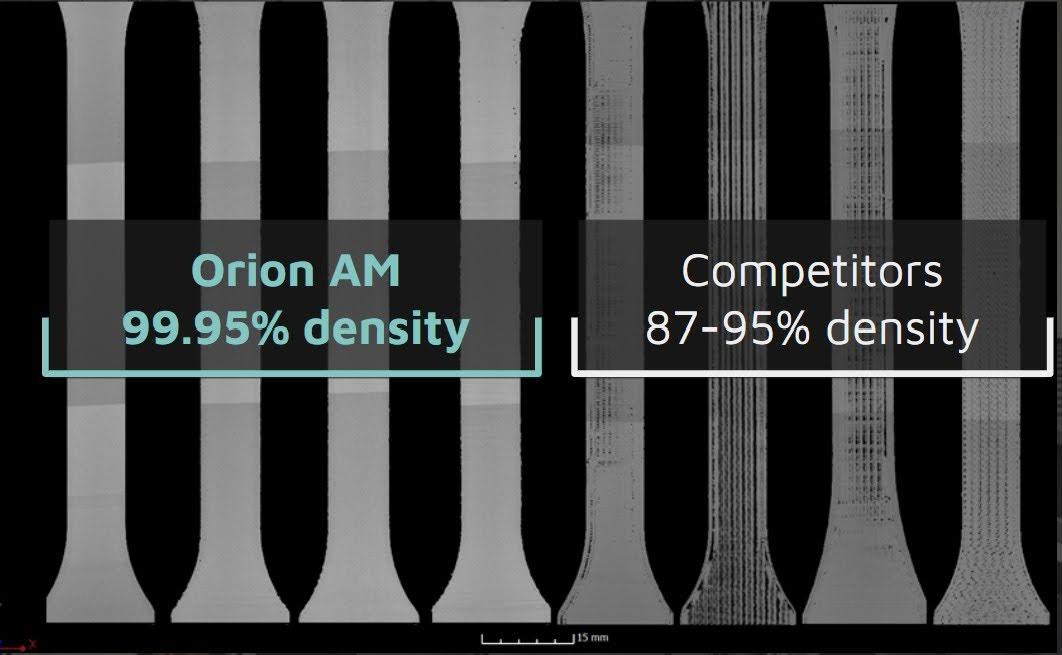
- Up to 99.95% part density PEEK printing: Eliminates internal porosity, making our process capable of producing hermetically sealed 3D printed parts for vacuum and submerged applications.
- 90+ MPa Z-axis strength 3D print: Consistently achieves or exceeds the tensile strength of traditional injection molding (about 90 MPa, varying per filament material), validating our systems for load-bearing, end-use parts production.
Applications
Orion AM's TRH process unlocks additive manufacturing for ultra-high-temperature polymers in new aerospace and medical applications.
Fully Bonded Structures
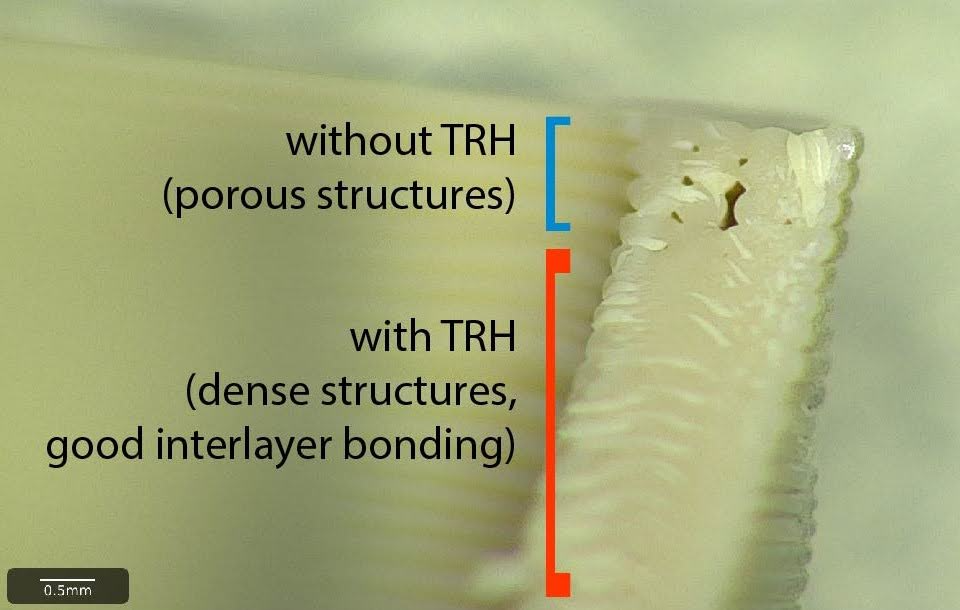
The effects of Thermal Radiation Heating (TRH): with our TRH system on, the part's internal structures are fully bonded, dense, and without voids. Each layer is fused to the ones above and below it.
Contrast this with the standard approach (TRH off), highlighted in blue: without proper and consistent heating, voids appear between printed lines and the layers, resulting in weaker, more porous parts.
Solid Infill
A computerized tomography (CT) scan of Orion AM's specimens shows an average void content of less than 0.05%, meaning that the internal density of the structures are 99.95% dense, which is comparable to injection molding or CNC machining.
Unrivaled Strength
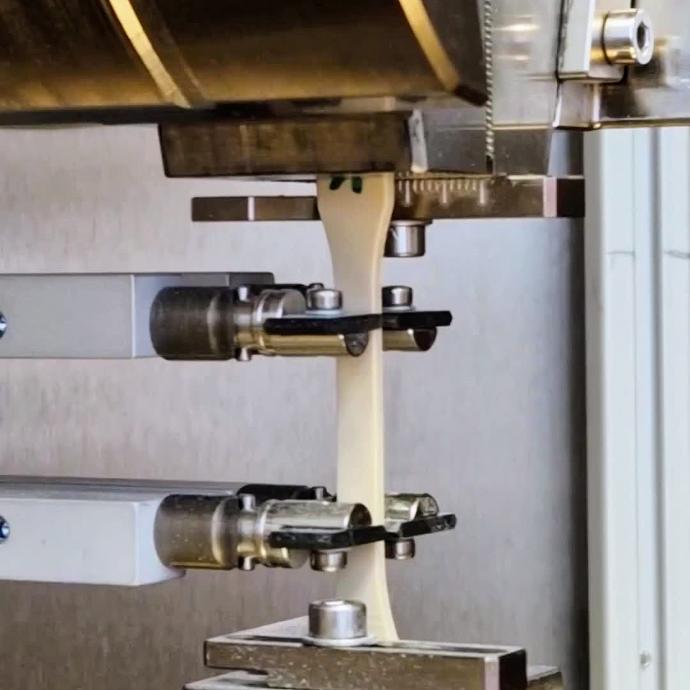
Orion AM's 3D printing process has been validated with various PEEK material suppliers. The tensile strength results speak for themselves.
Industrial Grade PEEK Filaments

KetaSpire®
PEEK
Tensile Strength (MPa)
Injection Molding Strength: 91 MPa
INFINAM®
9359F
Tensile Strength (MPa)
Injection Molding Strength: 90 MPa
Victrex
AM™450FIL
Tensile Strength (MPa)
Injection Molding Strength: 98 MPa

LUVOCOM® 3F PEEK 9581 NT
Tensile Strength (MPa)
Injection Molding Strength: 95 MPa
KetaSpire®
PEEK CF
Tensile Strength (MPa)
Injection Molding Strength: 159 MPa
Medical/Implantable Grade PEEK Filaments

Invibio PEEK-OPTIMA® LT1
Tensile Strength (MPa)
Injection Molding Strength: 100 MPa

VESTAKEEP® PEEK i4 3DF
Tensile Strength (MPa)
Injection Molding Strength: 94 MPa

TECAFIL PEEK VX MT
Tensile Strength (MPa)
Injection Molding Strength: 100 MPa
Other High Performance Polymers
Victrex
AM™200FIL
Tensile Strength (MPa)
Injection Molding Strength: 90 MPa
Radel®
PPSU
Tensile Strength (MPa)
Injection Molding Strength: 74 MPa